A support tool can hold estate-wide authority
ConnectWise published its ScreenConnect security bulletin on 19 February 2024. It identified CVE-2024-1709, an authentication bypass, and CVE-2024-1708, a path traversal issue. The affected self-hosted server releases were 23.9.7 and earlier; 23.9.8 was the original minimum release addressing the reported vulnerabilities. The bulletin was subsequently updated with additional release and maintenance guidance.
The Canadian Centre for Cyber Security warned about exploitation and the potential for remote code execution. The vendor distinguished the affected server from the endpoint agents and described remediation of its hosted services. Those distinctions are important when assigning work: an organisation using a remote-support agent does not necessarily operate the vulnerable public server.
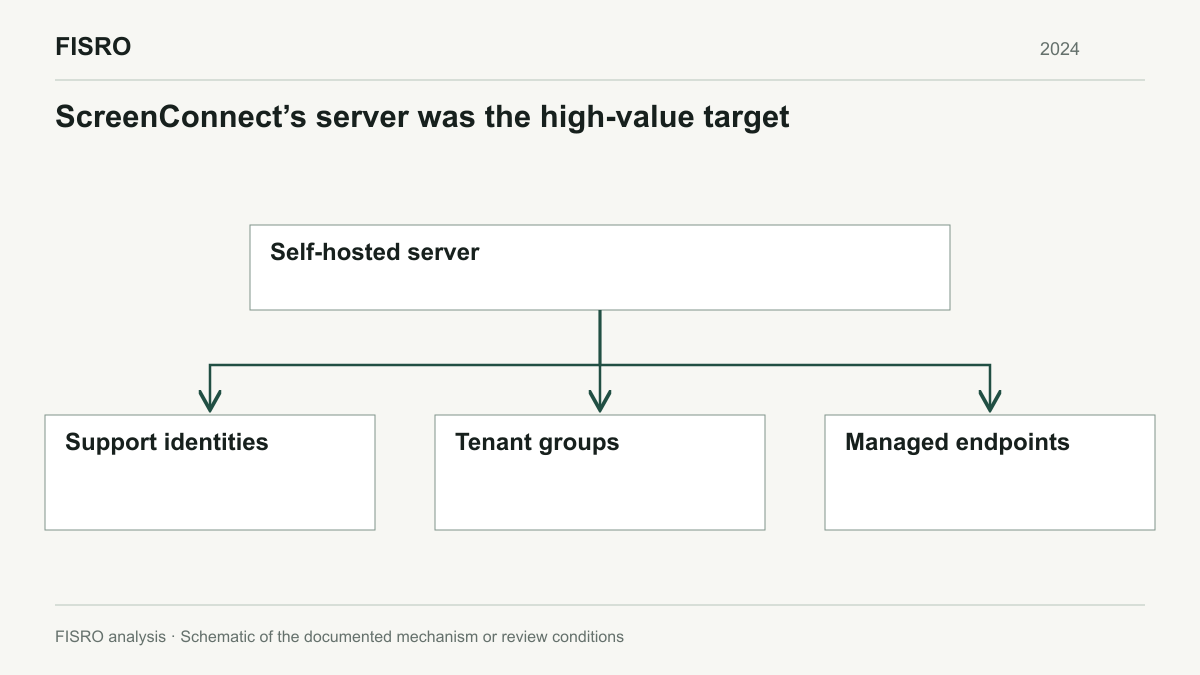
The reason to prioritise the server is the authority concentrated there. A successful compromise of a remote-management platform can change the response scope from one appliance to the systems that platform is permitted to administer.
Before the maintenance window
Establish who operates the server. In a managed-service arrangement, that may be the organisation, its support provider or another hosting party. Record the exact service endpoint and the party able to patch, restrict access and preserve evidence. A ticket sent only to the endpoint team may never reach the server owner.
Preserve the available server, account and session records needed for investigation. Identify privileged users, integrations and relevant changes during the exposure period. Use vendor and incident-response guidance for the actual product release; the absence of one known artefact should not be treated as a complete compromise assessment.
Review the platform's reach before changing it. Which endpoint groups can it administer? Which administrative accounts can create sessions or alter configuration? What separate route can responders use if the platform must be isolated? These questions determine both containment options and the services affected by them.
During containment and update
The update and the investigation should have coordinated owners. The update team closes the documented vulnerable route. The response team assesses earlier access, suspicious accounts, session activity and changes made through the platform.
If the evidence supports compromise, follow the organisation's incident plan for the server and the endpoints that may have received attacker activity. An upgrade of the management software cannot independently establish the state of a remotely controlled machine.
Maintain a separate trusted administration path. Introducing replacement credentials through an environment still considered compromised can expose the new credentials as well. The response plan should specify where recovery actions are performed and how their results are recorded.
Before reconnecting the estate
Require an explicit return-to-service decision. It should identify the software state, accounts and integrations reviewed, preserved evidence and remaining investigation work. If some endpoints remain unresolved, record them as a defined population rather than hiding them inside an overall service-restored status.
For a support provider, the handover also needs a customer-impact boundary. Which customers shared the affected control plane? Which administrative identities crossed those boundaries? Which customers need their own downstream investigation? The answers should follow available evidence, not an assumption that every managed endpoint experienced the same activity.
What a procurement review can test
Read the service configuration before assigning the ticket
On a supported Windows server, an authorised administrator can inspect services whose registered names match ScreenConnect:
Get-CimInstance Win32_Service |
  Where-Object { $_.Name -like '*ScreenConnect*' } |
  Select-Object Name, StartName, PathName, State
This reads configuration; it does not update or stop the service. A match can help identify the installed server components and configured identity. A missing match is inconclusive if the service was renamed, the deployment uses another platform or the inventory was taken on an endpoint rather than the server.
Obtain the exact server release using the vendor-supported interface or package record. Do not infer server patch state from the endpoint agent's version. Retain both records when the organisation needs to coordinate server and agent maintenance, with a clear statement of which record addresses the documented vulnerability.
The executable path and service identity should stay in the internal evidence package. The public conclusion can describe the affected role and response without exposing the organisation's administrative layout.
Give tenant boundaries a testable meaning
For a managed-service provider, select two synthetic customer groups. Establish which support identities can administer each group and which server-level role can change that assignment. Then ask what happens to both groups if that server-level role is considered compromised.
Record whether isolation can be performed per tenant, whether the relevant audit records are independently retained, and which customer contact can authorise disruptive maintenance. If the platform cannot provide a particular boundary, document the resulting shared failure domain rather than drawing two separate boxes that imply stronger isolation.
This exercise produces a concrete customer-impact map. It does not require exploitation of ScreenConnect or access to real customer sessions, and it does not establish that a vulnerability was used against the provider.
Ask a provider to walk through the compromise of its management server using a synthetic scenario. Request the points at which it could isolate a tenant, suspend a privileged identity, preserve logs and contact the relevant customer team. A generic statement about strong security does not answer those operational questions.
The SolarWinds case concerned a different route into management software. Both make the platform's legitimate privileges central to impact assessment. CitrixBleed adds a related warning about access objects that may survive an entry-point fix.
The practical conclusion is to inventory remote-management systems by the authority they hold. Product and version belong in that record, alongside tenant reach, privileged identities, independent recovery access and the evidence needed to establish how the platform was used.