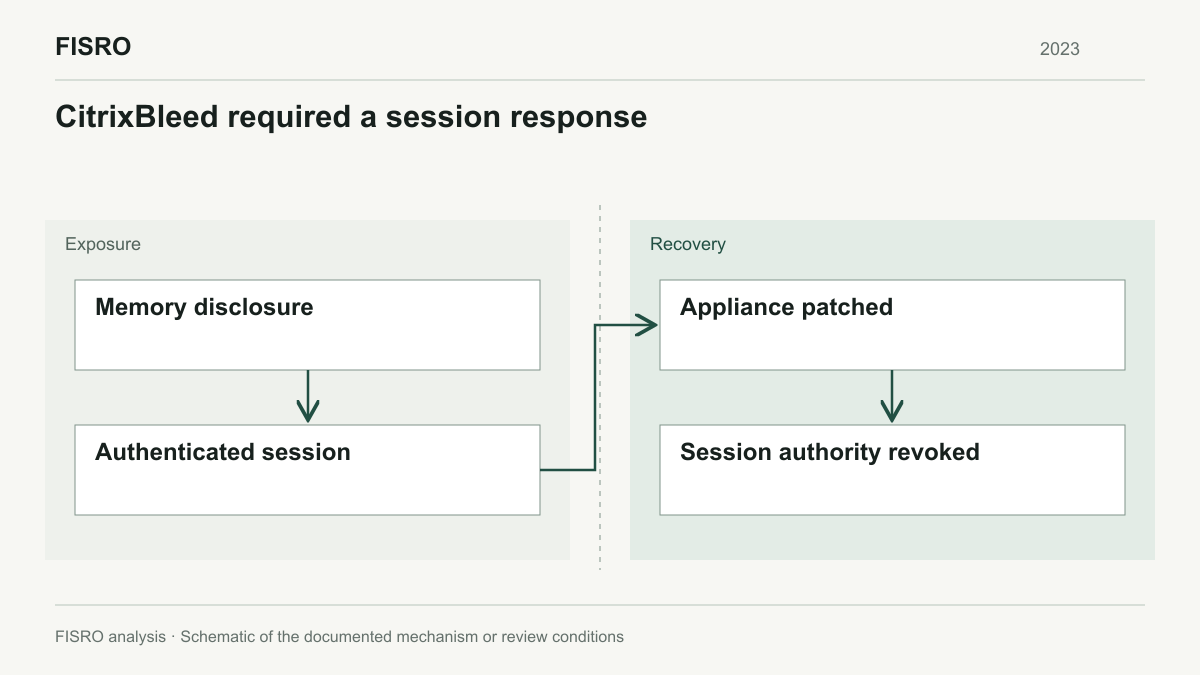
The memory leak and the session have different lifetimes
Citrix's bulletin for CVE-2023-4966 describes unauthenticated sensitive-information disclosure in customer-managed NetScaler ADC and Gateway deployments configured in the relevant Gateway or AAA roles. Mandiant's investigation connected exploitation to session hijacking. The incident became known as CitrixBleed.
This combination changes the recovery question. Fixing the software addresses further use of the vulnerability. An authenticated session obtained before the fix may represent a separate access path whose lifetime is governed by session handling. Remediation therefore has to address both the affected appliance and the authority already extracted from it.
The bulletin also distinguishes customer-managed products from Citrix-managed cloud services. Its affected-product statement should not be expanded into a claim that every service using Citrix branding had the same exposure.
Describe the access object precisely
Responders routinely use the word credentials for several different objects: passwords, session tokens, API keys and device certificates. Their invalidation behaviour is not interchangeable.
For a suspected session theft, ask which service accepts the token, how it expires, whether revocation is supported and what existing connections remain usable. A password replacement may be part of recovery, but its effect on established sessions must be verified rather than assumed.
| Response action | Decision it supports | What it does not establish alone |
|---|---|---|
| Install the vendor fix | Close the identified vulnerable implementation | Whether earlier sessions remain usable |
| Follow documented session invalidation | Remove the relevant existing session authority | Whether the attacker established another foothold |
| Review account and access activity | Investigate use of the stolen authority | Complete visibility if records were not retained |
| Assess downstream systems | Bound consequences beyond the appliance | That every unusual event came from this vulnerability |
Keep each action's result in the handover. Combining them into a single patch-complete field hides the distinction the incident requires.
Reconstruct the exposure window before cleaning up
Establish the appliance release, configuration role and internet reachability during the relevant period. Preserve the records needed by the vendor's investigation guidance before maintenance removes or rotates them. Compare access patterns with the organisation's expected user and administrative activity.
Mandiant's published findings concern the intrusions it investigated. They provide a mechanism and investigation context; they do not prove that a particular reader's environment had the same follow-on activity. Use the local evidence to decide whether sessions were abused and what the corresponding identities could reach.
Do not rely on a session source address alone to identify an actor or rule out misuse. Legitimate proxying and an attacker's use of intermediate infrastructure can complicate the picture. Correlate timing, identity, device context where available and the actions performed after access.
Test revocation as an operational capability
Read the historical product boundaries carefully
The vendor's original bulletin lists distinct release branches. For the ordinary supported branches, its fix boundaries included 14.1-8.50, 13.1-49.15 and 13.0-92.19. FIPS and NDcPP builds had separate entries; the bulletin also identified an end-of-life branch. These are historical product boundaries, not a recommendation to deploy an old release today.
Use the exact product and branch when comparing an appliance with the bulletin. Do not apply a standard-branch number to a specialised build, or infer the customer-managed appliance's status from a cloud service's remediation statement. Record the product identity and vendor evidence together.
A read-only software-version check can establish one prerequisite for assessment. It does not establish the configuration role during the exposure window, whether the vulnerable interface was reachable or whether a session was stolen. Those are additional facts with different evidence sources.
Define success before invalidating the test session
For a dedicated test account, write down the expected access paths and the specific state each observation will test. A refused new sign-in, an invalidated browser session and a closed existing connection are separate results. Use the product's current supported procedure and avoid publishing real session identifiers in the exercise notes.
Have a second authorised operator verify the resulting state through the documented interfaces. If a session remains accepted somewhere, preserve the context and investigate whether the procedure covered that component or whether another access object is involved. Do not assume that one successful logout proves fleet-wide invalidation.
The exercise should also identify the operational cost: who is interrupted, how users regain legitimate access and who can authorise the action during an incident. A revocation procedure that nobody is willing or able to invoke quickly is a weak recovery capability, even if it works in isolation.
A controlled exercise can use a dedicated test account and a documented session. Ask the team to apply the supported invalidation procedure and verify the result across the relevant interfaces. Record the difference between preventing a new login, terminating a session and closing an existing connection.
That exercise should not use production users' session material. Its purpose is to find gaps in the runbook and ownership: who can revoke access, which systems must participate, and how the result is observed.
The AiTM phishing case arrives at a similar response problem through a different entry point. A phishing proxy acquires session material during authentication; CitrixBleed concerns disclosure from an affected appliance. In both, the response must follow the reusable session rather than treating a password change as a universal reset button.
The practical improvement is a session-response section in the remote-access runbook. It should name the product procedure, preservation requirements, revocation owner and downstream review. That is a capability a team can test before the next vulnerability disclosure.