A short update window created a much longer recovery problem
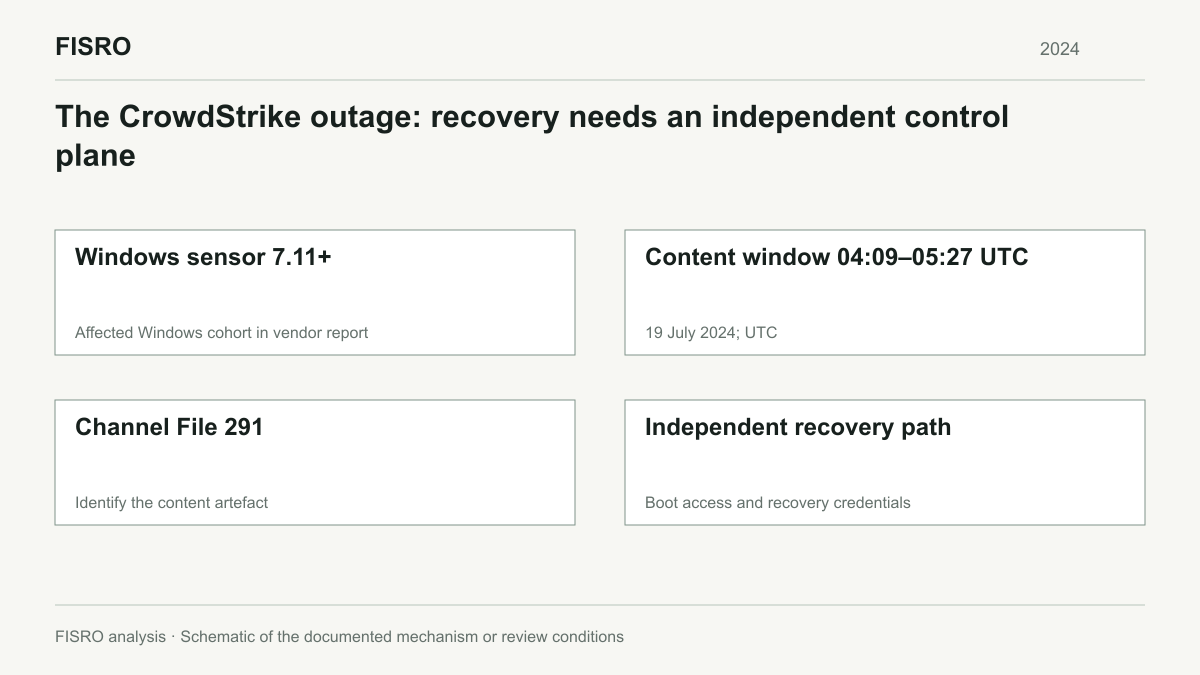
On 19 July 2024 at 04:09 UTC, CrowdStrike released a Windows sensor content configuration update that triggered system crashes on affected hosts. The company says it remediated the content at 05:27 UTC. Its technical account distinguishes the Channel Files involved from kernel drivers, even though the files use a .sys extension.
CrowdStrike described the incident as a faulty update, rather than a cyberattack. Microsoft's 20 July response estimated that 8.5 million Windows devices were affected. That was Microsoft's estimate at the time, not an independently measured FISRO total and not a count of separate organisations.
The difference between the distribution window and the recovery window matters. Stopping the delivery of bad content prevents additional exposure through that mechanism. It does not necessarily restore a machine that can no longer start normally or reach its management agent.
The recovery control plane may share the failure
Endpoint management, identity services, remote access and documentation are often treated as tools available during an outage. A correlated endpoint failure can affect those tools together. The resilience question is therefore whether an operator can recover the estate while the normal administration path is unavailable.
| Dependency | Recovery question | Evidence from an exercise |
|---|---|---|
| Management agent | Can a failed host receive remote instructions? | Tested route for a host that cannot boot normally |
| Disk encryption | Can an authorised responder obtain recovery material? | Access record and approved retrieval procedure |
| Identity and access | Can the recovery team authenticate independently? | Working emergency access tested under controlled conditions |
| Runbooks | Can responders read instructions during the outage? | Accessible, current offline or independent copy |
| Supplier updates | Who decides when delivery can resume? | Named decision owner and restart criteria |
This is a proposed exercise framework, not a statement that any named customer lacked those controls.
Stage content with the same seriousness as code
CrowdStrike published a root-cause analysis on 6 August 2024. The existence of a content update rather than a conventional software release does not make the operational consequence small. If a parser or interpreter runs with powerful system access, a change in its input can still be a fleet-wide availability event.
For buyers and operators, a supplier review should ask which changes can be staged, how health signals pause expansion, what rollback actually reaches, and how quickly customers can identify the affected cohort. A promise that updates are tested is less actionable than a description of rollout boundaries and failure detection.
Do not assume an ordinary endpoint rollback procedure works on a host that has lost its normal boot path. Recovery design needs to include the state in which the usual agent is unavailable.
Measure restoration by service
A count of online machines can help track fleet recovery, but the business outcome is the restoration of required services. Group hosts by the functions they support and the dependencies that must return first. A small unavailable cohort can block a critical workflow even when the overall online percentage looks reassuring.
For a tabletop exercise, choose a synthetic affected group and ask which team can authorise recovery, retrieve required access material and communicate service status. Record the elapsed time to a working service and any step that depended on an unavailable system. The goal is to discover circular dependencies before a real incident.
The supply-chain comparison has a limit
The xz backdoor and tj-actions compromise concern malicious changes. This incident concerns defective content. All three motivate scrutiny of trusted distribution paths, but combining them under an undifferentiated attack label erases the evidence about cause.
FISRO's assessment is that recovery independence belongs in security architecture reviews alongside prevention. A trusted product can fail without being controlled by an attacker, and the organisation still needs a way to restore its services.
Identify the affected cohort before touching files
CrowdStrike's technical account identifies Windows Falcon sensors 7.11 and later that downloaded the relevant content during 04:09–05:27 UTC on 19 July 2024. The company said Mac and Linux hosts were not affected by this incident. A machine being Windows-based was therefore insufficient to place it in the affected cohort.
| Condition | Meaning for this incident | Evidence still needed locally |
|---|---|---|
Windows sensor 7.11+ with the relevant content in the window |
Within the vendor's potentially affected cohort | Actual host state and content acquisition evidence |
| Mac or Linux host | Outside the vendor's stated affected platform population | Assess unrelated failures separately |
A current Channel File with a .sys extension |
Not automatically the defective historical content | Content identity and timestamps interpreted through vendor guidance |
The implicated content was Channel File 291, with filenames beginning C-00000291-. The vendor explains that these Channel Files are configuration content, not kernel drivers despite their extension. Confusing the file type can send a recovery team towards the wrong change model.
A read-only file inventory is not a deletion instruction
On an authorised Windows host or appropriately mounted evidence copy, a narrow inventory can read matching filenames and timestamps:
Get-ChildItem -LiteralPath "$env:windir\System32\drivers\CrowdStrike"   -Filter 'C-00000291-*.sys' |
  Select-Object Name, Length, LastWriteTimeUtc
In PowerShell, place the command on one line or use its documented line-continuation syntax when adapting it. The example reads records; it does not remove files or disable protection. A matching filename is expected to require interpretation because legitimate content uses that naming pattern too.
Follow the vendor's supported recovery procedure for the actual host state. Do not turn a retrospective's path example into a blanket instruction to delete current security content. Preserve evidence and the service owner’s decision where an incident review requires them.
The important restoration dependencies
The provider corrected content delivery during the incident, but a host unable to boot normally could need another recovery route. That makes availability of encryption recovery material, a usable console and an independent identity part of the service's recovery design.
The WannaCry case combined an exploit-driven outage with shared-service dependencies. NotPetya added destructive propagation and privileged identities. This event involved defective vendor content. The comparison is about recovery architecture, not a claim that the cause was malicious in all three cases.
Use a synthetic exercise to remove the ordinary endpoint agent and authentication route from the recovery plan. Ask the team to restore one useful service, record elapsed steps and identify any circular dependency. Test the workflow with authorised recovery material; do not reproduce the faulty content on production systems.
A useful supplier handover should explain rollout boundaries, content identity, failure detection and the recovery path customers can actually use. The operational result is a restored service with known outstanding work, rather than a fleet-wide percentage that hides a critical blocked dependency.