A vendor can also be a downstream victim
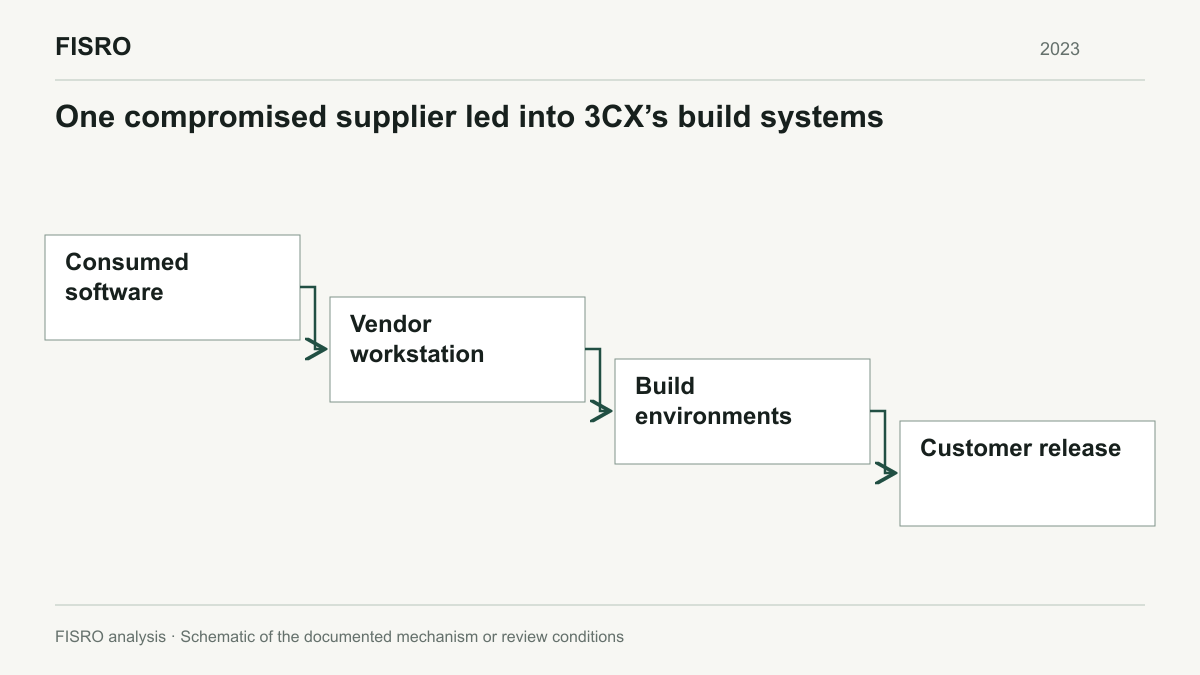
In April 2023, Mandiant published an investigation linking the compromise of the 3CX Desktop App to an earlier compromise of X_TRADER software distributed by Trading Technologies. Its response work traced an initial infection into the 3CX environment and then into Windows and macOS build systems. Customers subsequently received trojanised communications software through a legitimate distribution route.
CISA had alerted customers to reports of the 3CX supply-chain attack on 30 March. The distinction between that initial warning and the later reconstruction matters: the existence of malicious customer software was established before the upstream chain was fully explained publicly.
The case expands the usual supplier diagram. A software supplier is not only a producer of dependencies for its customers. Its employees and build operators also consume software, and a compromise at that earlier layer can become a production problem for everyone downstream.
Draw the workstation into the release boundary
Release-system reviews often begin at source control and end at the signing step. The 3CX record is a reason to ask how an attacker could reach that chain from an ordinary software installation elsewhere in the organisation.
That does not mean a developer workstation should never run non-development applications. It means access from that workstation to release authority needs to be understood and constrained. The boundary should survive the compromise of a tool that was not itself part of the product's dependency graph.
| Transition | Question for the supplier | Evidence worth requesting |
|---|---|---|
| Workstation to engineering | Which credentials or sessions bridge the two? | Access design and separation of roles |
| Engineering to build | Who can change a release job or its inputs? | Protected workflow and change records |
| Build to signing | Can a build invoke signing without another policy decision? | Signing policy and audit trail |
| Signing to distribution | Which artefact identity do customers receive? | Release digest and provenance record |
The answer should describe actual enforcement. A policy document saying that production is separate is less useful than an explanation of which identities can cross the boundary.
A valid signature is one fact about an artefact
Digital signing remains valuable for checking provenance and integrity. It does not independently establish that the producing environment was free from intrusion. An attacker who influences the legitimate release path may produce an artefact that passes the checks customers were taught to perform.
Customer response therefore needs the supplier's affected-release guidance and evidence from local execution, not only a signature result. Preserve the precise installer or package identity, installation time, execution records and relevant security observations. Where an affected application had access to browser or other sensitive state, let the incident assessment determine the resulting credential review.
Avoid inferring confirmed data theft from installation alone. An affected package, an executed malicious component and observed follow-on activity are different findings. That distinction helps responders prioritise without discarding the wider exposure population.
Test the supplier's recovery story
Capture the installer identity before replacing it
On Windows, these read-only commands inspect an already collected local installer:
Get-FileHash -LiteralPath '.\collected-installer.exe' -Algorithm SHA256
Get-AuthenticodeSignature -LiteralPath '.\collected-installer.exe' |
  Select-Object Status, StatusMessage, SignerCertificate
The filename is illustrative. Do not download or execute a suspected installer to use this example. Work from evidence collected under the incident process, with the original preserved and the analysis copy handled appropriately.
The digest identifies the exact collected file. The signature result describes a signing relationship and the verifier's view of it. A valid result does not demonstrate benign contents; an invalid result does not identify the attacker. Preserve both alongside collection time and origin so they can be compared with the supplier's affected-artefact information.
For macOS packages or another distribution format, use the platform's supported inspection tools and the same evidence principle. Do not infer one platform's affected release from the other platform's version label. The build and distribution records must support that connection.
Ask which alerts would have crossed the supplier boundary
In a synthetic supplier exercise, begin with suspicious behaviour on a workstation that has a route into release engineering. Ask when endpoint responders would involve the release team and when customers would receive an affected-artefact notice.
If every team waits for a complete attribution before changing distribution or preserving build records, the process may fail to address an urgent artefact-integrity question. Conversely, customer communication should distinguish a suspected build exposure from a confirmed malicious release. Define those decision thresholds in advance, with evidence and accountable owners.
This makes the exercise concrete without claiming that FISRO investigated the vendor's internal alerting process or discovered a missed warning in this incident.
A useful supplier question is how release trust would be re-established after a build-environment compromise. Reinstalling a build server is only one step if signing access, workflow identities or source-control permissions were also exposed.
Ask which credentials were replaced, which systems were rebuilt from trusted material, how changes to the pipeline were reviewed, and what independent evidence supports the clean release. Some details may remain confidential, but the supplier should be able to explain the scope and decision process without turning a remediation claim into a marketing assurance.
The SolarWinds case illustrates a trusted update channel reaching customer management environments. xz illustrates a different release-artefact problem. 3CX adds a cascade: software consumed inside one vendor became a route into software produced for others.
The practical procurement insight is to ask about the inputs to the supplier's release authority, including workforce software and administrative identities. A dependency list for the finished product will not show that entire path.